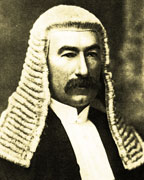
The 1907 Harvester Judgment.was a seminal judgement in Australian industrial relations history when Justice Higgins found that employees had to be paid a "living wage", a wage based on fairness (as determined by the court) and not on the company's ability to pay. Ever since, this judgment has been enshrined by the union movement while it cast a long pall over Australia's economic progress for seven decades.
Hugh Victor McKay patented an effective machine for stripping, threshing and bagging grain crops in 1885. An improved model, the Sunshine Harvester, was built from 1893. The business boomed, and by 1904 McKay's had become the largest manufacturing exporter in the Commonwealth.
The Sunshine Harvester factories in Victoria were modern and efficient, and they employed a large number of workers. Operations were eventually concentrated at Braybrook, just west of Melbourne, where the works became the basis of an industrial town called Sunshine.
McKay could be benevolent, but he was also autocratic. Implacably opposed to wage regulation, he was often in bitter conflict with the trade unions. In 1907 McKay was involved in a celebrated court case which became known as the Harvester judgement.
Justice H.B. Higgins, the president of the Commonwealth Arbitration Court, declared that an unskilled labourer should receive a minimum of seven shillings for an eight-hour working day, enough to sustain himself and his family in "frugal comfort". Adjusted over time, this became the Basic Wage, the basis for the pay of most Australian workers for the next sixty years.
In November 2007 the far left-wing Minister for Education, Minister for Employment and Workplace Relations Julia Gillard (who in 2010 became Australia's first female Prime Minister), when introducing the new Fair Work industrial relations legislation, likened the Harvester Judgment to an "uncodified" but "highly influential social clause of the Australian Constitution". That is real faith and it is bedrock union tradition (Paul Kelly, "Gillard caught in workplace trap", The Australian,
April 02, 2011).